


This guide is general information and is not legal advice. Consult an Oregon landlord-tenant attorney about your situation.

A tired landlord in Oregon has four ways out: hire a property manager, agree on a move-out with cash for keys, end the tenancy for a reason ORS 90.427 allows, or sell the house with the tenant in place or vacant. Each route has its own notice rules, costs and timeline, so start with the one that matches your goal.
Key points
- A tired landlord can hire a property manager, agree on a move-out with cash for keys, end the tenancy by law or sell the house.
- After the first year of a tenancy, ORS 90.427 requires a qualifying reason and at least 90 days’ written notice, or 60 days for a sale to a buyer who will live in the house (SB 586).
- A tenant can end a month-to-month tenancy with 30 days’ written notice.
- Oregon caps annual rent increases at 9.5% for 2026 and 10% for 2027 for most buildings that are 15 years or older.
- A buyer who purchases an occupied house takes the tenancy as it stands, so the tenant keeps the current lease.
If you are a tired landlord, you have reached a point many owners reach. The work, the stress and the legal rules weigh more than the rent you collect.
This guide lays out your options in Oregon, what state law says about ending a tenancy, and how selling the house with the tenant in place works.
Table of contents
1. Why landlords get tired
Owning a rental often starts as a good plan. A house, a tenant and monthly rent look like a steady way to build income. Over time, the plan can turn into a long list of headaches.
Rent that arrives late, repairs that arrive early, and rules that keep changing add up.
Some costs show up without warning. A big repair, a vacancy or a tenant who stops paying leaves you covering the mortgage, taxes and insurance while the rent stops.
A rental also ties up equity. The money in the house stays there until you sell, so a need for cash is hard to meet, and the mortgage, taxes, insurance and maintenance continue every month.
Or perhaps your tenant pays rent, but you are still on the hook for the mortgage payment, maintenance and taxes.
Maybe you’ve owned the property for a few decades and have already taken all the depreciation you can take, so there is no longer any tax benefit.
Or maybe you wanted to treat the tenant fairly and kept rents low. But over time, increases in property taxes and insurance have outpaced rents, and you are now losing money.
If you feel worn out, you are in good company. The rest of this guide shows the routes out and what Oregon law says about each one.
2. Your ways out
Most landlords land on one of these routes. Pick the one that fits your timeline and how much work you want to take on.
Hire a property manager and continue to rent it
What you do. Hand the day-to-day to a manager and keep the property.
Pros. More professional management and better compliance with Oregon and Portland’s ever-changing rental laws. No more calls from tenants, and no more time spent on maintenance, tenant selection or tenant issues.
Cons. Management fees, typically 8%, eat into your profits. Furthermore, management companies carry less incentive to control costs than you do. So when a maintenance issue arrives, they will send out their preferred contractor and send you the bill. Owner-landlords typically save significant money on repairs by using their own people, and getting multiple bids.
Sell it
If you choose to sell the property, you will need to decide whether to sell it with a tenant in place or sell it vacant.
Selling with a tenant in place
Pros. This option is generally the easiest, with the least amount of friction. The easiest route is to sell to a cash home buyer, like Better Off Home Buyers. We will buy the property from you with the tenant in place. We can close in two weeks, and you avoid the legal minefield of evictions, notices to tenants and relocation fees.
If you decide to sell the traditional way with a tenant in place, this creates added complications, although you may be able to net more. Potential complications include a tenant who refuses to allow the property to be shown to prospective buyers, or who offers very little availability for showings.
Some tenants who want to be uncooperative can leave the house in disorder, so that instead of presenting its best, the home presents its worst. Some tenants believe it is in their best interest to turn off buyers so that they can stay in the house longer, or to thwart a sale entirely.
If this is the case with your house and your tenant, and if you don’t want to sell it to a cash buyer, then your best bet is to make the house vacant so that you can list it. To get the house vacant, you generally have three options: 1) cash for keys, 2) a no-cause eviction (only available in the first year of the tenancy) or 3) a for-cause eviction.
Cash for keys
Pros. This is the fastest way to get your property vacant. It avoids a lengthy legal battle and further property damage. It is a risk mitigation strategy, because an eviction can lead to unintended consequences, such as the tenant counter-suing the landlord. If this happens, all of your decades of equity that you’ve accumulated can be wiped out in an expensive lawsuit or judgment.
Cons. Typically, in Portland as of 2026, you have to pay upwards of $10,000 in cash for keys. Some tenants will even hold out for more. If you can negotiate a cash for keys agreement of $5,000, this would be considered a very good deal.
Tips. A cash for keys agreement should spell out how much money is being paid by the landlord to the tenants, to whom it is being paid, when it is being paid, the payment method, and the final vacate date when the tenants hand over the keys. You can negotiate this on your own, and a landlord-tenant attorney should draw up the agreement. If done incorrectly, the tenants can take the cash for keys money, still stay in the property, and you will find yourself back where you started, facing an expensive and time-consuming eviction. A landlord-tenant attorney can draft the agreement for you, and our list of Portland attorneys who handle difficult tenant issues is a good place to start.
End the tenancy by law
What you do. Give written notice for a reason Oregon law allows.
What you take on. Notice periods, paperwork, possible payments to the tenant and the costs of the house until you sell or re-rent.
What you skip. The day-to-day of that tenancy once it ends. Our guide to cash for keys in Portland covers the move-out payment in detail.
Notice periods under ORS 90.427
Oregon’s landlord-tenant law (ORS 90.427) sets the rules for ending tenancies. The numbers below come from the statute.
30 days
The written notice a tenant gives to end a month-to-month tenancy at any time.
90 days
The written notice a landlord gives for a qualifying reason after the first year. The notice drops to 60 days when you sell to a buyer who will live there (see below). Shorter timelines apply in some shared-property cases.
Relocation assistance
1 month
The rent a landlord pays when giving that notice, unless the landlord owns four or fewer units. The 60-day notice for a sale to a buyer who will live there adds an additional month’s rent.
3 months
The rent a landlord owes, plus damages, when a termination breaks the rules.
During the first year of occupancy, the rules differ from the rest of the tenancy. After the first year, a landlord ends a month-to-month tenancy for tenant cause or for one of these landlord reasons, each with at least 90 days’ written notice (60 days for a sale to a buyer who will live there, explained below):
- Demolition or conversion. You plan to tear down the unit or change it to a non-residential use.
- Repairs or renovations. The work will make the unit unsafe or unfit during or before the project.
- Your own move-in. You or an immediate family member will live in the unit as a primary residence, and you own no comparable available unit in the same building.
- A buyer who will live there. You accepted an offer from a buyer who plans to occupy the unit as a primary residence, and you give notice with written evidence within 120 days of accepting the offer. Since September 2025, SB 586 lets you give 60 days’ notice instead of 90 for this reason. You need an accepted offer, you include written evidence of the offer with the notice, and you pay the tenant an additional month’s rent.
The notice states the reason and the facts behind it, and the termination date falls at least 90 days after delivery (60 days for a sale to a buyer who will live there). A landlord who skips these steps owes the tenant three months’ rent plus actual damages, and the tenant has a defense in an eviction case.
Owners of a property with no more than two units who live in the same building follow a shorter timeline under subsection (8), and some landlords with four or fewer units skip the payment. Portland adds its own relocation assistance for qualifying terminations. The Portland Housing Bureau sets the amounts by unit size, for example $2,900 for a studio and $3,300 for a one-bedroom, and they can exceed one month of rent. Confirm the current figures on the Portland Housing Bureau relocation assistance page before you send a notice. A landlord-tenant attorney confirms which rules fit your property. Our list of landlord attorneys in Portland is a starting point.

3. Rent increases and what they mean for your numbers
Oregon caps annual rent increases for most buildings that are 15 years or older. The Office of Economic Analysis sets the cap each year as 7% plus the change in the consumer price index, with a ceiling of 10%. The maximum is 9.5% for 2026 and 10% for 2027. A landlord can raise rent once in a 12-month period.
Check the current figure on the state rent stabilization page before sending any notice. If the capped rent leaves the property below your costs, that is a reason many owners start thinking about selling.
Rent increases above 10% will trigger mandatory relocation assistance if the tenants reject the rent increase.
4. Selling the house with your tenant in place
A sale ends your role as landlord without waiting for a move-out. Better Off Home Buyers buys houses as they are, with tenants or without.
This route suits owners who want out and prefer to skip a tenant transition. You skip the move-out timeline, the cleaning and the repairs a regular listing needs. Additionally, an investor who buys the house with the tenant takes over the existing tenancy, and the tenant keeps the current lease.
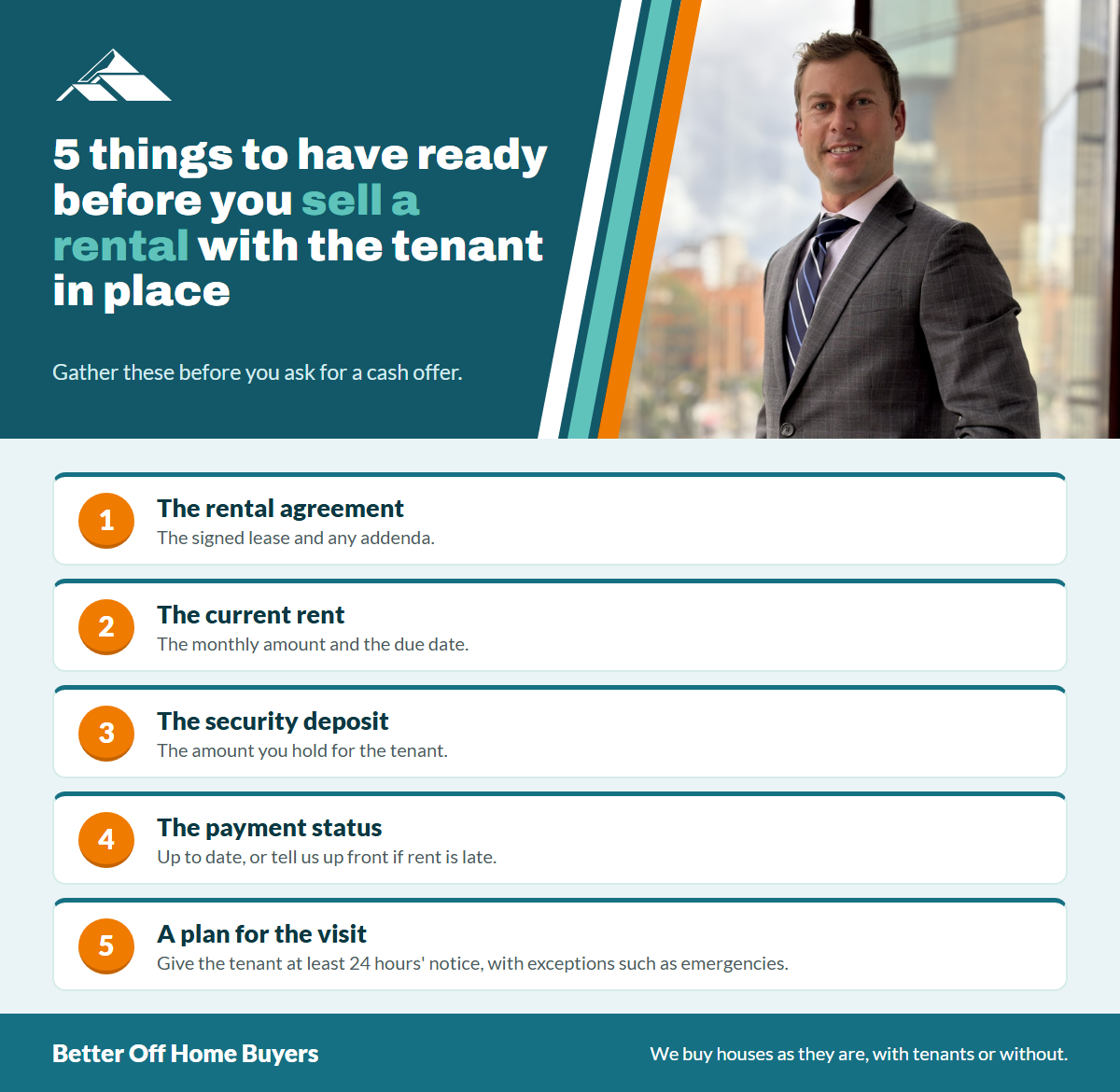
A buyer who purchases an occupied house takes the tenancy as it stands. Share the rental agreement, the rent amount and the deposit details early so the offer reflects the whole picture. Our guide to selling a rental with tenants covers the process from the landlord’s side.
If the tenant has stopped paying rent, tell us up front. Oregon has a notice and court process for nonpayment, and the details shape the offer. Ask a landlord-tenant attorney how the security deposit passes to the new owner at closing.
A visit works best with the tenant’s cooperation. Oregon law requires at least 24 hours’ notice before a landlord enters the unit, with exceptions such as emergencies, so schedule the visit with the tenant early and have the lease, current rent and deposit amount ready.
5. Compare a regular sale with a cash sale
When does it make sense to sell the traditional way with a realtor, versus a cash sale to an investor like Better Off Home Buyers
A regular listing can bring more exposure and suits owners who have time and a house that shows well. A cash sale suits owners who want to sell as it is, with or without the tenant, and prefer a simpler path. An agent can also list an occupied rental, so ask about that option too. Our compare page puts the two side by side, and this guide to selling costs in Portland lists what a regular sale adds up to.
6. How a sale to Better Off Home Buyers works
Contact us by form or phone and tell us about the house and the tenancy. We schedule a visit, review the property, and discuss an offer. The offer can go up or down, based on other terms, such as the time to close and tenancy status.
If you find yourself in a situation where the tenant refuses to give us access to the property, we can still buy the house based on an exterior drive-by only.
After you accept, we start the paperwork and close. The full process is on our how we buy houses page, and our purchased houses page shows homes we have bought.
If you want a cash offer, call us at (888) 827-0889 or use the form.
Frequently asked questions
Can I sell a rental house in Oregon with the tenant still living in it?
Yes. You can sell a rental while the tenant lives there. Better Off Home Buyers buys houses with tenants in place and as they are.
How much notice do I give a tenant to end a month-to-month tenancy in Oregon?
After the first year of occupancy, a landlord needs a qualifying reason and at least 90 days’ written notice under ORS 90.427. If you sell to a buyer who will live in the house, SB 586 allows a 60-day notice with an accepted offer, written evidence of it and an additional month’s rent. A tenant can end a month-to-month tenancy with 30 days’ written notice.
Do I pay the tenant when I end the tenancy?
Under ORS 90.427, a landlord with an ownership interest in more than four units pays one month’s rent when delivering a qualifying notice. Landlords with four or fewer units are exempt from that payment. The 60-day notice for a sale to a buyer who will live there requires an additional month’s rent. Local rules, such as Portland’s, can add requirements.
How much can I raise the rent in Oregon?
For most buildings 15 years or older, the maximum is 9.5% for 2026 and 10% for 2027, once in a 12-month period. The Department of Administrative Services publishes the figure each year, so check its page before you send a notice.
What if my tenant stops paying rent?
Oregon has a notice and court process for nonpayment. A landlord who removes a tenant without a court order faces liability, so involve an attorney early. If you decide to evict your tenant, whether it is a for-cause or no-cause eviction, definitely make sure that you use a landlord friendly attorney. If you try to do it on your own, chances are you will make a mistake. The law is very complex, and any tiny error such as counting the days wrong, sending the wrong form at the wrong time, missing the notice periods by even a day, will cause your eviction petition to be denied. This results in delayed timelines, increased costs, and ultimately increased liability. Multiple failed attempts at eviction can result in the tenants arguing that you are retaliating against them, and this may mean that you will never be able to evict them. You can start with our list of landlord-friendly attorneys we recommend in Portland.
What happens to my tenant if I sell the house?
The sale on its own keeps the tenancy going. The buyer takes the house with the tenant in place unless you end the tenancy under ORS 90.427 or the tenant moves out first.
Can I sell a rental that needs repairs?
Yes. We buy houses as they are, so repairs, damage and deferred maintenance can stay on the list for the new owner.
Disclosure: this guide is written by Better Off Home Buyers, a company that buys rental houses. Sources: ORS 90.427 and the Oregon Department of Administrative Services.
Tired of being a landlord?
A cash offer you can accept or decline.
Keep reading
Cash for keys in Portland
A clean exit for you and the tenant.
Selling a house with tenants without legal headaches
The sale from the landlord’s side.
Top 5 landlord attorneys in Portland
Where to get legal help.
Tell us about your rental
Share the address, the lease, the rent, whether the tenant is paying and what shape the house is in. Our team reviews the details with you and you decide whether to accept the offer.